Free resources · GCSE Mandarin topics
GCSE Mandarin: Global issues
Free vocabulary, grammar and Higher model answers with exam tips for the GCSE Mandarin topic “Global issues” (the environment; poverty and homelessness). Click a section to open it.
Key vocabulary
| Chinese | Pinyin | English |
|---|---|---|
| The environment | ||
| 环境 | huánjìng | environment |
| 垃圾 | lājī | rubbish |
| 浪费 | làngfèi | to waste; waste |
| 空气 | kōngqì | air |
| 交通 | jiāotōng | traffic |
| 有害的 | yǒuhài de | harmful |
| 全球变暖 | quánqiú biànnuǎn | global warming |
| 气候变化 | qìhòu biànhuà | climate change |
| 洪水 | hóngshuǐ | flooding |
| 风险 | fēngxiǎn | risk/hazard |
| 保护 | bǎohù | to protect |
| 回收 | huíshōu | to recycle |
| 分类垃圾 | fēnlèi lājī | to sort rubbish |
| 节约 | jiéyuē | to save (energy, water) |
| 减少 | jiǎnshǎo | to reduce |
| Protecting the environment | ||
| 水 | shuǐ | water |
| 电 | diàn | electricity |
| 少开车 | shǎo kāichē | to drive less |
| 多种树 | duō zhòng shù | to plant more trees |
| 多走路 | duō zǒulù | to walk more |
| 关灯 | guān dēng | to turn off the lights |
| 节省 | jiéshěng | to save (money, energy) |
| 节约水 | jiéyuē shuǐ | to save water |
| 节约食物 | jiéyuē shíwù | to save food; not to waste food |
| 保护环境 | bǎohù huánjìng | to protect the environment |
| 回收垃圾 | huíshōu lājī | to recycle rubbish |
| 回收水瓶 | huíshōu shuǐpíng | to recycle water bottles |
| Pollution | ||
| 污染 | wūrǎn | pollution |
| 空气污染 | kōngqì wūrǎn | air pollution |
| 水污染 | shuǐ wūrǎn | water pollution |
| 环境污染 | huánjìng wūrǎn | environmental pollution |
| Poverty and society | ||
| 社会 | shèhuì | society |
| 生活 | shēnghuó | life |
| 人口 | rénkǒu | population |
| 增加 | zēngjiā | to increase |
| 住房 | zhùfáng | housing |
| 穷 | qióng | poor |
| 富 | fù | rich |
| 贫穷 | pínqióng | poor; poverty |
| 失业 | shīyè | unemployed |
| 小偷 | xiǎotōu | thief |
| 罪行 | zuìxíng | crime |
| 乞丐 | qǐgài | beggar |
| 战争 | zhànzhēng | war |
| 饥饿 | jīè | hunger |
| Weather | ||
| 天气 | tiānqì | weather |
| 天气预报 | tiānqì yùbào | weather forecast |
| 气候 | qìhòu | climate |
| 是晴天 | shì qíngtiān | it is sunny |
| 是阴天 | shì yīntiān | it is overcast |
| 有云 | yǒuyún | it is cloudy |
| 有风 | yǒufēng | it is windy |
| 刮风 | guāfēng | to be windy |
| 有雾 | yǒuwù | it is foggy |
| 下雨 | xiàyǔ | to rain |
| 下小雨 | xià xiǎoyǔ | light rain, showers |
| 下雪 | xiàxuě | to snow |
| 下大雪 | xià dàxuě | heavy snow |
| 热 | rè | hot |
| 冷 | lěng | cold |
| 暖和 | nuǎnhuo | warm |
| 凉快 | liángkuai | cool |
| 星 | xīng | star |
| 月亮 | yuèliàng | moon |
| Seasons | ||
| 季节 | jìjié | season |
| 春天 | chūntiān | spring |
| 夏天 | xiàtiān | summer |
| 秋天 | qiūtiān | autumn |
| 冬天 | dōngtiān | winter |
Grammar and complex structures
Use these in your speaking and writing.
| Structure | Meaning | Example for this topic |
|---|---|---|
| 越来越…… | more and more … | 天气越来越热了。 The weather is getting hotter and hotter. |
| 为了…… | in order to … | 为了保护环境,我们应该少用电。 To protect the environment, we should use less electricity. |
| 如果……就…… | if … then … | 如果我们不保护环境,问题就会越来越大。 If we don’t protect the environment, the problems will get bigger and bigger. |
| 首先……其次……最后…… | first … secondly … finally … | 首先,我们应该分类垃圾;其次,要少用电;最后,要多骑自行车。 First, we should sort our rubbish; secondly, use less electricity; finally, cycle more. |
| 我觉得最大的问题是…… | I think the biggest problem is … | 我觉得最大的问题是全球变暖。 I think the biggest problem is global warming. |
| 比如说…… | for example … | 我们可以帮助环境,比如说少坐飞机。 We can help the environment, for example by flying less. |
Speaking questions and model answers
Try answering each question yourself first, then click it to see a Higher model answer and an exam tip.
Photo card
The photo card task follows the AQA format, but the same skills are useful for the picture-based task in the Pearson Edexcel GCSE Chinese speaking exam.
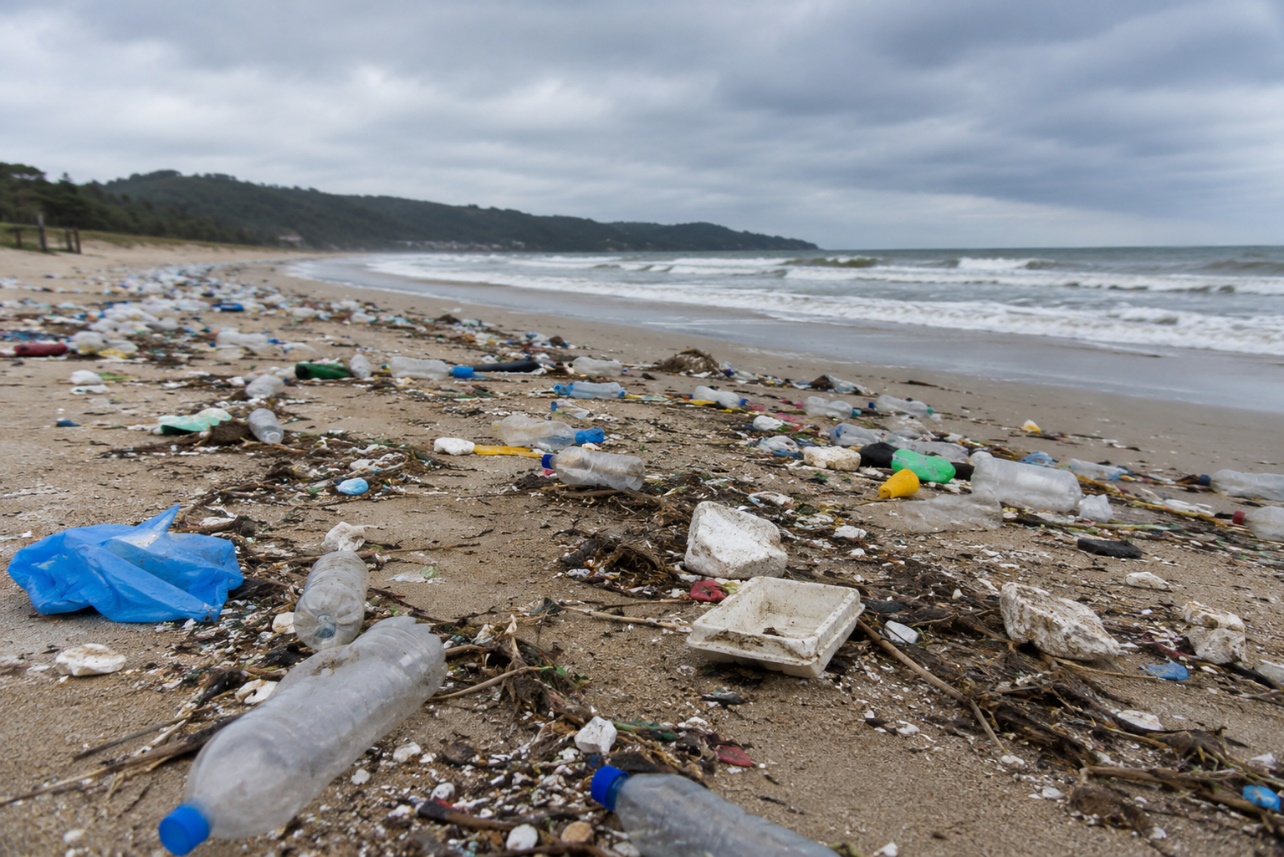
A photo of a beach with a lot of rubbish.
Photo card照片里有什么?What is in the photo? Show model answer
照片里有很多垃圾和水瓶在海边,没有人。我觉得这对环境很不好,因为垃圾太多了。
In the photo there is lots of rubbish and there are lots of water bottles on the beach, and nobody is there. I think this is very bad for the environment, because there is too much rubbish.
Exam tip: Describe only what you can see: say what there is (垃圾, 水瓶) and what there isn’t (没有人). Complex structures: ……对环境很不好 (……is bad for the environment), ……,因为…… to give a reason, and 太……了 (垃圾太多了 – “far too much rubbish”).
Edexcel tip: Describe what you can see in the picture first, and read each question carefully for key words.
General conversation
Questions your teacher may ask about this topic.
General conversation你为保护环境做了什么?What have you done to protect the environment? Show model answer
为了保护环境,我每天骑自行车去学校,不坐汽车。在家里,我们分类垃圾,也少用电。上个月我和同学在海边收了很多垃圾。将来我打算少坐飞机,因为飞机对环境有害。
To protect the environment, I cycle to school every day instead of going by car. At home we sort our rubbish and use less electricity. Last month my classmates and I collected lots of rubbish on the beach. In the future I plan to fly less, because planes are harmful to the environment.
Exam tip: Complex structures: 为了……, ……对环境有害. Time frames: past (上个月……收了很多垃圾) and future (将来我打算……).
General conversation你觉得世界上最大的问题是什么?What is the biggest problem in the world? Show model answer
我觉得最大的问题是全球变暖。去年夏天英国非常热,很多地方没有下雨。天气越来越热,洪水也越来越多。如果我们不保护环境,将来的问题就会更大。
I think the biggest problem is global warming. Last summer it was extremely hot in Britain and many places had no rain. The weather is getting hotter and hotter, and there are more and more floods. If we don’t protect the environment, the problems will be even bigger in the future.
Exam tip: Complex structures: 越来越 + adjective, 如果……就……. Time frames: past (去年夏天……) and future (将来的问题就会更大). Vocabulary: 全球变暖, 洪水.
General conversation你觉得我们应该怎么帮助穷人?How should we help poor people? Show model answer
在我住的城市,冬天常常有人在马路上睡觉,因为他们没有房子。去年冬天我和妈妈给他们送了一些食物和衣服。我觉得我们应该多帮助他们。将来我想去慈善商店工作。
In the city where I live, people often sleep in the street in winter, because they don’t have a home. Last winter my mum and I took them some food and clothes. I think we should help them more. In the future I want to work in a charity shop.
Exam tip: Complex structures: 在我住的城市 (the city where I live), ……,因为…… (他们没有房子), 给 + person + verb (给他们送了一些食物和衣服), 应该多 + verb (应该多帮助他们). Time frames: past (去年冬天……送了) and future (将来我想……). Vocabulary: 食物, 慈善商店.
General conversation今天天气怎么样?明天呢?What is the weather like today? And tomorrow? Show model answer
昨天下了一天雨,可是今天是晴天。虽然有点儿冷,但是很舒服。天气预报说明天会下大雪,所以我打算在家看电影。
Yesterday it rained all day, but today it is sunny. Although it is a bit cold, it is very pleasant. The weather forecast says it will snow heavily tomorrow, so I plan to stay at home and watch a film.
Exam tip: Complex structures: 虽然……但是……, ……,所以……. Time frames: past (昨天下了一天雨) and future (明天会下大雪).
More general conversation questions to practise
- 你住的地方环境怎么样? (What is the environment like where you live?)
- 你认为垃圾回收重要吗?为什么? (Is recycling important? Why?)
- 你以前帮助过别人吗?你怎么帮助别人? (Have you helped other people before? How do you help others?)
- 你小时候住的地方环境怎么样? (What was the environment like where you lived when you were little?)
- 将来你想为环境做什么? (What would you like to do for the environment in the future?)
- 你最喜欢什么季节?为什么? (Which season do you like best? Why?)
Questions about this topic
What does the topic “Global issues” cover in GCSE Mandarin?
It covers the environment; poverty and homelessness. The topic can come up in speaking, writing, reading and listening, so learn the vocabulary and practise the speaking questions out loud.
What is the difference between the photo card and the general conversation?
In the photo card task you describe a photo and answer questions about it. In the general conversation your teacher asks questions about the topic, and you should give opinions, reasons and use past, present and future time frames. This page has model answers for both.
How can I make my answers sound more advanced?
Give opinions with reasons, use past, present and future time frames, join ideas with connectives such as 虽然……但是……, and add specific details or examples.