Free resources · GCSE Mandarin topics
GCSE Mandarin: Customs and festivals
Free vocabulary, grammar and Higher model answers with exam tips for the GCSE Mandarin topic “Customs and festivals” (festivals and customs in chinese-speaking countries and communities). Click a section to open it.
Key vocabulary
| Chinese | Pinyin | English |
|---|---|---|
| Festivals | ||
| 节日 | jiérì | festival |
| 春节 / 中国新年 | chūnjié / zhōngguó xīnnián | Spring Festival / Chinese New Year |
| 新年 | xīnnián | new year |
| 中秋节 | zhōngqiūjié | Mid-Autumn Festival |
| 端午节 | duānwǔjié | Dragon Boat Festival |
| 圣诞节 | shèngdàn jié | Christmas |
| 复活节 | fùhuójié | Easter |
| 过生日 | guò shēngrì | to celebrate a birthday |
| Food and customs | ||
| 饺子 | jiǎozi | dumpling |
| 月饼 | yuèbǐng | mooncake |
| 粽子 | zòngzi | sticky rice dumpling |
| 红包 | hóngbāo | red envelope (lucky money) |
| 舞龙 | wǔlóng | dragon dance |
| 舞狮 | wǔshī | lion dance |
| 鞭炮 | biānpào | firecrackers |
| 放 | fàng | to set off (firecrackers) |
| 灯笼 | dēnglóng | lantern |
| 龙舟 | lóngzhōu | dragon boat |
| Gifts and guests | ||
| 礼物 | lǐwù | gift |
| 送礼物 | sòng lǐwù | to give gifts |
| 收 | shōu | to receive |
| 感谢 | gǎnxiè | thankful, gratitude, to thank |
| 请 | qǐng | to invite |
| 邀请 | yāoqǐng | to invite |
| 客人 | kèren | guest |
Grammar and complex structures
Use these in your speaking and writing.
| Structure | Meaning | Example for this topic |
|---|---|---|
| ……的时候 | when … | 过春节的时候,中国人吃饺子。 At the Spring Festival, Chinese people eat dumplings. |
| 跟……一样 / 不一样 | the same as / different from … | 春节跟圣诞节不一样。 The Spring Festival is different from Christmas. |
| 一边……一边…… | doing two things at the same time | 我们一边吃饭一边看电视。 We watch TV while eating. |
| 虽然……但是…… | although … | 虽然我不是中国人,但是我很喜欢过春节。 Although I am not Chinese, I love celebrating the Spring Festival. |
| 最重要的是…… | the most important thing is … | 过节的时候,最重要的是全家在一起。 At festival time, the most important thing is that the whole family is together. |
| 如果……就…… | if … then … | 如果有机会,我就去中国过春节。 If I get the chance, I will spend the Spring Festival in China. |
Speaking questions and model answers
Try answering each question yourself first, then click it to see a Higher model answer and an exam tip.
Photo card
The photo card task follows the AQA format, but the same skills are useful for the picture-based task in the Pearson Edexcel GCSE Chinese speaking exam.
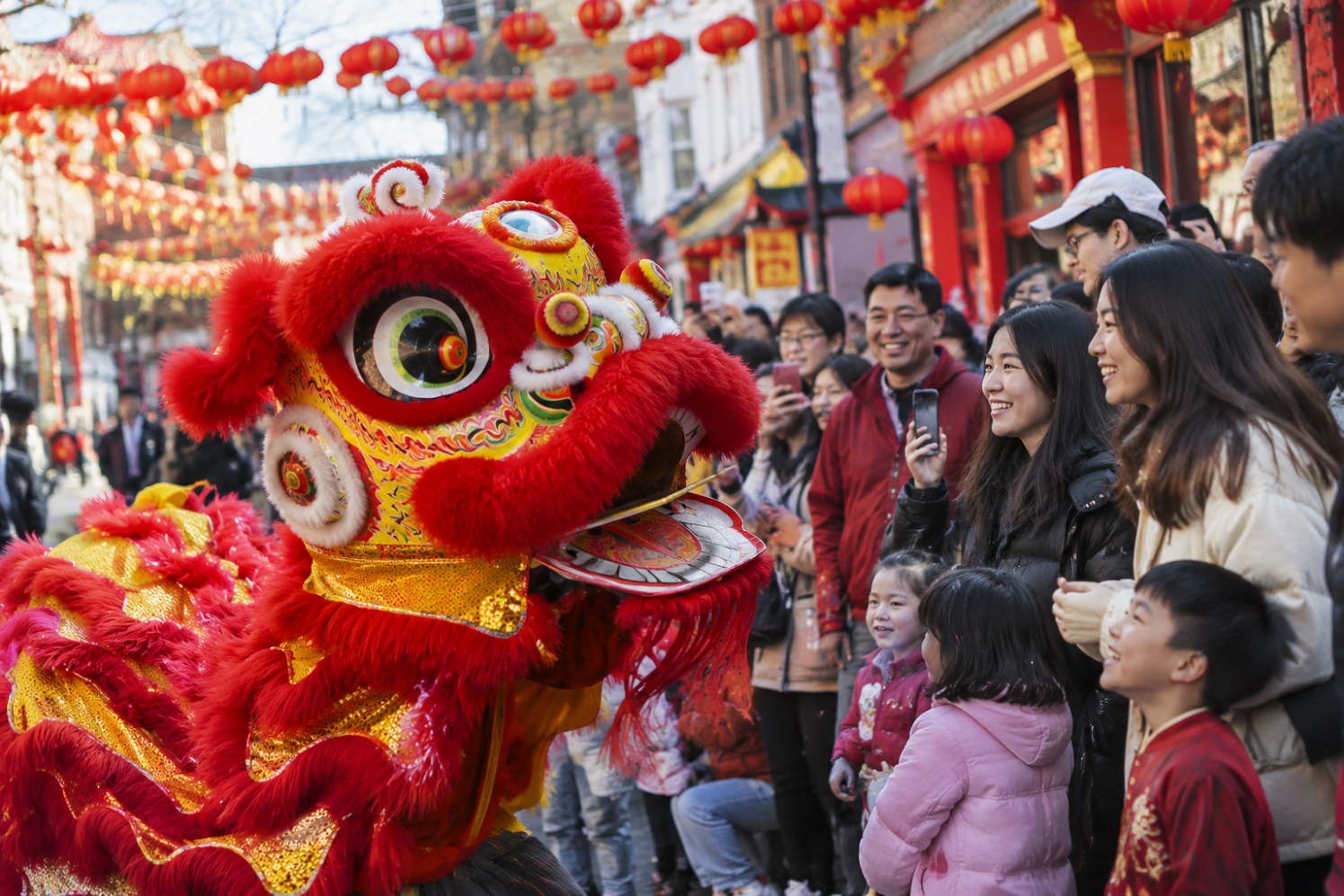
A photo of a lion dance in a street with red lanterns.
Photo card照片里有什么?What is in the photo? Show model answer
照片里有很多人在看舞狮。大街上有很多红色的灯笼。我觉得这可能是春节,因为舞狮和红灯笼都是春节的东西。大家看起来很高兴,因为他们都在笑。
In the photo lots of people are watching a lion dance. There are lots of red lanterns in the street. I think it might be the Spring Festival, because lion dances and red lanterns are part of the Spring Festival. Everyone looks happy, because they are all smiling.
Exam tip: Use 我觉得…… to say what you think is happening, and back it up with 因为 and details you can see (舞狮, 红灯笼).
Edexcel tip: Describe what you can see in the picture first, and read each question carefully for key words.
General conversation
Questions your teacher may ask about this topic.
General conversation你最喜欢什么节日?为什么?What is your favourite festival? Why? Show model answer
我最喜欢的节日是春节,因为不但可以吃饺子、看舞龙舞狮,而且孩子们可以收红包。虽然我不是中国人,但是我们学校每年都过春节。
My favourite festival is the Spring Festival, because not only can you eat dumplings and watch dragon and lion dances, but children also get red envelopes. Although I am not Chinese, our school celebrates the Spring Festival every year.
Exam tip: Complex structures: 不但……而且……, 虽然……但是……, 最喜欢的……是……. Vocabulary: 舞龙, 舞狮, 红包.
General conversation去年圣诞节你做了什么?What did you do last Christmas? Show model answer
去年圣诞节我们全家去了奶奶家。我们一起吃了火鸡,然后送礼物。我给奶奶送了一个蛋糕,她非常高兴。晚上我们一边吃饭一边看电视。今年圣诞节我们打算去叔叔家。
Last Christmas the whole family went to my grandma’s. We had turkey together and then gave presents. I gave my grandma a cake and she was very happy. In the evening we watched TV while we ate. This Christmas we plan to go to my uncle’s.
Exam tip: Complex structures: 一边……一边……, ……然后……. Time frames: past (去了, 吃了, 送了) and future (今年圣诞节我们打算……).
General conversation你觉得春节和圣诞节有什么不一样?How is the Spring Festival different from Christmas? Show model answer
春节和圣诞节都是很重要的节日,大家都和家人一起吃饭。但是,过春节的时候,中国人吃饺子,给孩子红包;过圣诞节的时候,英国人吃火鸡,送礼物。去年我第一次和中国朋友一起过春节,觉得很有意思。明年我也想和他们一起过春节。
The Spring Festival and Christmas are both important festivals, when everyone eats with their family. But at the Spring Festival Chinese people eat dumplings and give children red envelopes; at Christmas British people eat turkey and give presents. Last year I celebrated the Spring Festival with Chinese friends for the first time, which was very interesting. Next year I also want to celebrate the Spring Festival with them.
Exam tip: Complex structures: ……的时候, comparing with 都 and 但是. Time frames: past (去年我第一次……) and future (明年我也想……).
General conversation将来你想去中国过节吗?Would you like to celebrate a festival in China in the future? Show model answer
我以前在电视上看过春节。如果有机会,我就去中国过春节,因为我想看舞龙,也想放鞭炮。我还想和中国朋友一起包饺子,因为包饺子很好玩儿。
I have seen the Spring Festival on TV before. If I have the chance, I will go to China for the Spring Festival, because I want to see a dragon dance and let off firecrackers. I would also like to make dumplings with Chinese friends, because it is great fun.
Exam tip: Complex structures: 如果……就……, verb + 过 (看过). Time frames: past (我以前在电视上看过……) and future (如果有机会,我就去中国……).
More general conversation questions to practise
- 你怎么庆祝你的生日? (How do you celebrate your birthday?)
- 中秋节的时候,中国人会做什么? (What do Chinese people do at the Mid-Autumn Festival?)
- 去年你过生日的时候收到了什么礼物? (What presents did you get for your birthday last year?)
- 明年过生日的时候,你想做什么? (What would you like to do for your birthday next year?)
- 你觉得送礼物重要吗?为什么? (Is giving presents important? Why?)
- 英国有什么有名的节日? (What famous festivals are there in the UK?)
Questions about this topic
What does the topic “Customs and festivals” cover in GCSE Mandarin?
It covers festivals and customs in Chinese-speaking countries and communities. The topic can come up in speaking, writing, reading and listening, so learn the vocabulary and practise the speaking questions out loud.
What is the difference between the photo card and the general conversation?
In the photo card task you describe a photo and answer questions about it. In the general conversation your teacher asks questions about the topic, and you should give opinions, reasons and use past, present and future time frames. This page has model answers for both.
How can I make my answers sound more advanced?
Give opinions with reasons, use past, present and future time frames, join ideas with connectives such as 虽然……但是……, and add specific details or examples.